
LMTD and Heat Exchanger Calculator
1) LMTD (Log Mean Temperature Difference)
Counterflow
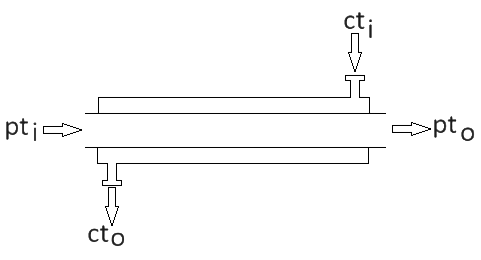
Parallel
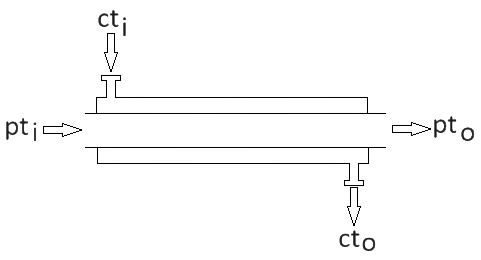
|
$$LMTD \, = {(dt_i-dt_o) \over log_{e}(dt_i/dt_o)}$$
|
| $$dt_i = pt_i - ct_o \,\,\,\,\,\,\, \,\,\,\,\,\,\, dt_o = pt_o - ct_i$$ |
| $$dt_i = pt_i - ct_i \,\,\,\,\,\,\, \,\,\,\,\,\,\, dt_o = pt_o - ct_o$$ |
Heat Transfer Medium
cti cto
cti cto
Product
pti
cpo
pti
Log Mean Temperature Difference
198.6
2) Heat Transfer Calculator
| $$ A = {\dot{M}\,C_{pp}(\,pt_i - pt_o) \over U\,lmtd } $$ |
Ṁ Cpp U Cpc
Heat Transfer Rate
344.44
kWHeat Transfer Area Required
3.02
m2Heat Transfer Flow Rate Required
2.22
kg/hr
Ṁ is the mass throughput (kg/hr)
Cpp is the specific heat of the product (kJ/kg K)
pti Is the temperature of the product entering the heat exchanger1
pt0 Is the temperature of the product entering the heat exchanger1
U is the overall heat transfer coefficient of the heat exchanger (W/m2 K)
Cpc is the specific heat of the product (kJ/kgK)
LMTD is the log mean temperature difference1
1From the LMTD calculation above.
Cpp is the specific heat of the product (kJ/kg K)
pti Is the temperature of the product entering the heat exchanger1
pt0 Is the temperature of the product entering the heat exchanger1
U is the overall heat transfer coefficient of the heat exchanger (W/m2 K)
Cpc is the specific heat of the product (kJ/kgK)
LMTD is the log mean temperature difference1
1From the LMTD calculation above.